
It is well-known, and the Brooks-Bhagat report vouches for it, that the real failure for the 1962 debacle against China was not military, but political, says Ram Madhav.
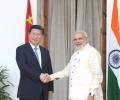
With the continuing stand-off in Ladakh casting a shadow over the Sino-India talks, Prime Minister Narendra Modi on Thursday raised 'serious concerns' over the repeated incidents along the border and sought an early settlement of the boundary question.

The elephant in the room will permeate the conversations, predicts Rup Narayan Das.

From early indications, the Modi government's foreign policy seems to be pragmatic and reciprocal, says K G Suresh.

Being a pragmatist Modi is not likely to give preference to China over Japan. Both security and economic aspects are likely to shape Modi's decision in terms of engaging the two biggest economies of Asia, says Sana Hashmi.

'Guarding the borders in extreme weather conditions is not easy and most people don't realize it is a very tough job.'

'India in 2020 is a lot better prepared than in 1962.' 'It is no longer a pushover; and anything other than a crushing Chinese military victory will be a major loss of face for China,' observes Rajeev Srinivasan in the first of a three part column.

Asked whether the IAF can play a role in smashing terrorist training camps across the Line of Control in Jammu and Kashmir, he did not rule out such a possibility.

People on the Ladakh sector of the border with China are compelled to ponder over a heart ripping prospect of a future in China -- a country they viscerally hate for steadily usurping their land. Their swelling disillusionment and popular frustration with India is fraught with grave geo-strategic and national security implications for the country. New Delhi's morbid indifference is indeed frightening, says R N Ravi.
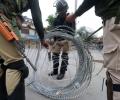
'If Islamic extremists regain power in Afghanistan, Pakistan will lead them to Kashmir as a fighting arena again. India needs to fortify Kashmir and prepare against these Islamic extremists before they come again.'
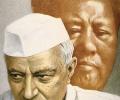
'Delhi was not concerned.' 'It would continue sleeping for several more years, with the result that Indian territory is still occupied by China today,' says Claude Arpi.

Two pilgrims -- Leela Narayanan Mandredath, 56, of Kerala and Satya Laxmi of Andhra Pradesh -- have died due to high altitude sickness in Simikot and heart attack in Tibet respectively, the Indian Embassy said.
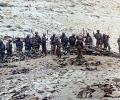
At least 38 PLA troops drowned while crossing a fast-flowing, sub-zero river in darkness, according to an article in the Australian newspaper The Klaxon which cited a report prepared by a group of social media researchers after a year-long investigation.

At least a couple of Chinese military helicopters were spotted flying close to the un-demarcated Sino-India border in the area after the fierce face-off on May 5 following which a fleet of Sukhoi-30 jets of the Indian Air Force too carried out sorties there, the sources said.

The Standing Committee on Water Resources has recommended renegotiating the Indus Water Treaty with Pakistan to address the impact of climate change on water availability in the river basin and other challenges which are not covered under the agreement.

The visit comes a week after 20 Indian Army personnel were killed in a brutal assault by the Chinese military in Galwan Valley which escalated the border tension.

A release from White House said Obama held in-depth, productive and candid discussions on the US-China relations and other issues of mutual interest.
The Indian Army will continue to maintain its aggressive posturing in all disputed areas in eastern Ladakh and will not back off till status quo is maintained, sources said.

One thing Beijing must understand is that India is not obsessed with being a threat to China but only wants a rightful place for itself in the world, says Sanjeev Nayyar.

This is her first visit to Beijing after she took over the office last year.

The decision to not attend the forum attended by 28 heads of state and 130 national delegations is a clear break from its usual policy of going along with the crowd.

'They know that India is no pushover.' 'We have to be extremely vigilant, remain ready and keep strengthening our positions.' 'We have to be militarily strong, whatever be the cost.'

For India to endorse Nepal's Buddhist conference will be like sipping from a poisoned chalice, warns former RA&W official Jayadeva Ranade.

'We keep saying that we have a very close historical, cultural, linguistic and religious affinity with Nepal. Then why be so insensitive that we cannot find time to talk to them for more than 5-6 months'

All the three issues raised by China at the Modi-Xi meeting are either intractable or peripheral to the bilateral relations and suggest conventional methods to placate the other side without yielding much, says Srikanth Kondapalli.
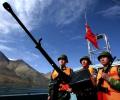
Both the Indian and Chinese armies have brought in more troops in sensitive locations like Demchok, Daulat Beg Oldie and areas around Galwan river as well as Pangong Tso lake in Ladakh, the sources said. The area around Galwan has been a point of friction between the two sides for over six decades.
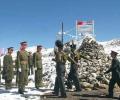
People familiar with the situation in the region said the two sides were engaged in trying to resolve the dispute, but there was no indication of a positive outcome yet as both the armies continued to bolster their positions in disputed areas of Pangong Tso and Galwan Valley and Demchok.
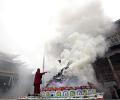
China has been keeping tabs on the restive Tibet province through a 'grid' system and some 600 'convenience police posts' armed with high-tech equipment that monitor the daily life of the citizens of Lhasa and other Tibetan towns. Worse, 'volunteer security groups' known as 'Red Armband Patrols' are roaming around in order to get more information and 'classify' each and every citizen, says Claude Arpi

'Why did your generals try to grab a few square kilometres of Indian territory in Ladakh?' 'And what happened to the hard work that you and Prime Minister Modi put into the Wuhan and Mamallapuram meets?' Claude Arpi writes a letter to Xi Jinping, China's self-styled supreme leader, who turns 68 today, June 15.

Prime Minister Narendra Modi's visit to Arunachal Pradesh on Friday, February 20, irritated the Chinese government so much that it summoned the Indian ambassador to register its protest against Modi visiting a territory China claims as Southern Tibet.

'China's growing nexus with Pakistan and the two countries' unresolved territorial disputes with India continue to pose a formidable national security threat to India,' says Brigadier Gurmeet Kanwal (retd).
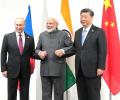
'Russia is the only country that can act as facilitator for any eventual Chinese-Indian rapprochement,' points out Ambassador M K Bhadrakumar.
In fact, given the current tensions and massed troops on both sides, there is a danger that the LAC will become more like the Line of Control with Pakistan, a heavily fortified and strongly defended border where weapon fire exchanges regularly occur. Indeed, Stratfor Worldview research has listed a sharp increase in new Chinese facilities along the LAC in 2019-20.

'Open conflict would be a disaster for both China and India.'
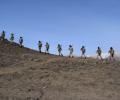
Indian military sources said no firearms were used in the clashes and that most of the injuries were sustained following stone-pelting and use of rods by the Chinese side.

In the review meeting, Singh told the top military brass to continue to deal with the situation in eastern Ladakh and other areas with "firmness".
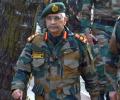
The commanders will also deliberate on the overall situation in Jammu and Kashmir besides delving into issues having national security implications, they said. However, the main focus will be on the situation in eastern Ladakh where Indian and Chinese troops are locked in an eyeball-to-eyeball face-off in Pangong Tso, Galwan Valley, Demchok and Daulat Beg Oldie, the sources said.

'Our love for our great nation -- Bharat is second to none and our patriotism towards our motherland -- India is for the entire nation to emulate.'

The billions India invested in dams, schools, etc in Afghanistan will be gone. The Hindu and Sikh population of Afghanistan has already shrunk from some 200,000 to about 500, points out Rajeev Srinivasan.

The government has sanctioned a dozen fresh SSB battalions, comprising over 13,000 personnel for the Nepal and Bhutan borders guarding force, to "fortify" defences along these fronts including the tri-junction area in Sikkim that adjoins Bhutan and Tibet, officials said.
